The study of topological phenomena in nanophotonic systems has emerged as one of the most exciting and rapidly evolving frontiers in modern photonics. Nanophotonics, with its extraordinary ability to confine and manipulate light at the nanoscale, provides a uniquely powerful platform for realizing and exploring topological photonic physics. When topological principles are embedded into nanoscale photonic architectures, entirely new regimes of light-matter interaction become accessible, where robustness, precision, and functionality converge in ways that neither field could achieve independently. This synthesis is not only expanding our fundamental understanding of light but is also charting new directions for next-generation photonic technologies in information processing, sensing, and quantum applications.
Recent advances in nanofabrication and material engineering have made it increasingly feasible to construct nanophotonic systems with well-defined topological properties, bringing theoretical predictions into experimental reality. The integration of van der Waals materials, moiré superlattices, and non-Hermitian design principles into nanoscale photonic platforms is opening new avenues for discovering and controlling topological states at deeply sub-wavelength scales. These developments are revealing profound connections between nanoscale light confinement and topological protection, driving both conceptual breakthroughs and practical innovations in robust waveguiding, nanoscale lasing, and on-chip quantum photonic circuits.
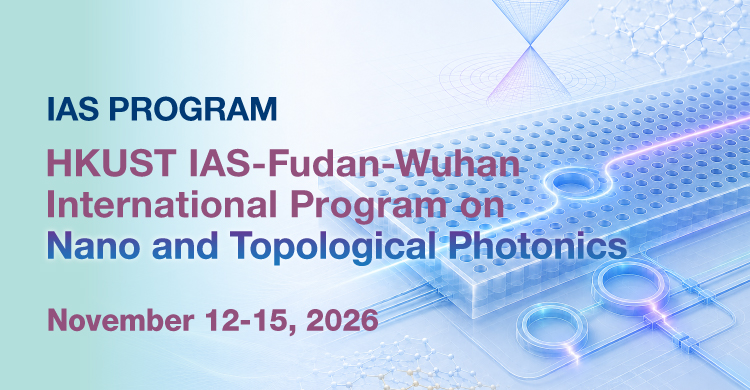
The symposium, jointly organized by HKUST-IAS, Fudan University, and Wuhan University, aims to bring together leading and active researchers to collectively explore the rich opportunities at the intersection of topological and nanophotonics. Scheduled for November 12–15, with a welcome reception on November 12, the program will convene prominent experts from the US, Europe, and across Asia under one roof. Leveraging Hong Kong's exceptional geographic accessibility and its role as a bridge between Eastern and Western scientific communities, the symposium provides an ideal platform for deep scientific exchange and cross-disciplinary dialogue. A central mission of this gathering is to foster new collaborative ties and accelerate progress in this emerging and vibrant research frontier.
Co-organizers